Archives par étiquette : NASA

Saturns Iapetus: Painted Moon

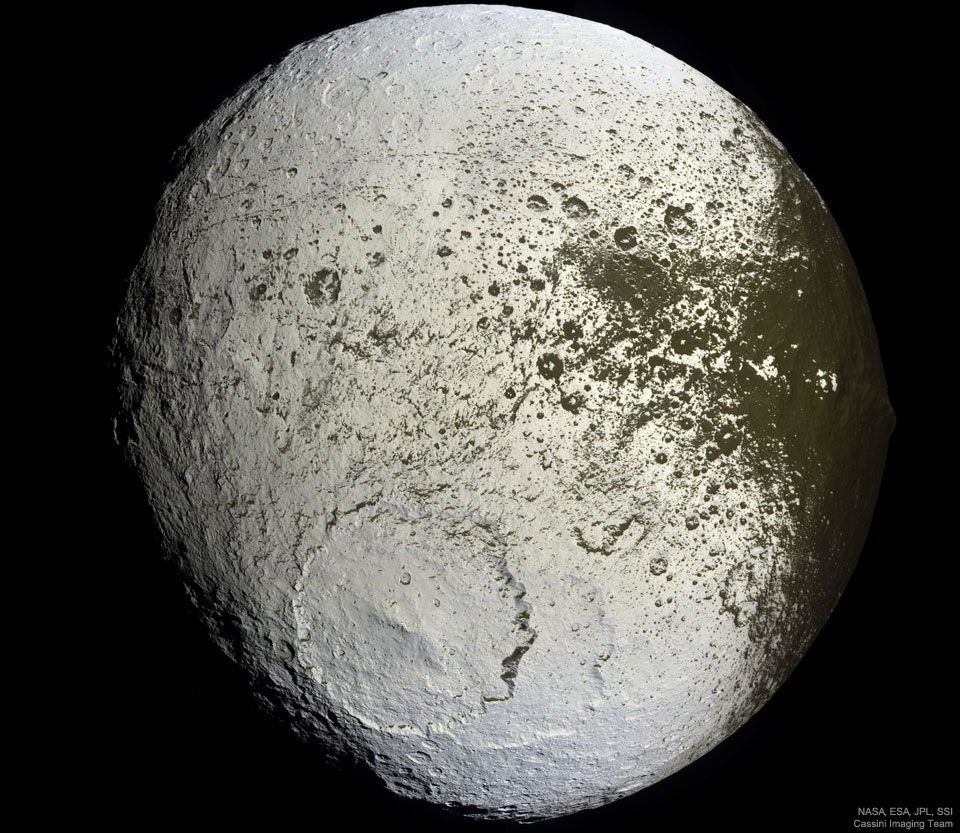
What has happened to Saturn’s moon Iapetus? Vast sections of this strange world are dark as coal, while others are as bright as ice. The composition of the dark material is unknown, but infrared spectra indicate that it possibly contains some dark form of carbon. Iapetus also has an unusual equatorial ridge that makes it appear like a walnut. To help better understand this seemingly painted moon, NASA directed the robotic Cassini spacecraft orbiting Saturn to swoop within 2,000 kilometers in 2007. Pictured here, from about 75,000 kilometers out, Cassini’s trajectory allowed unprecedented imaging of the hemisphere of Iapetus that is always trailing. A huge impact crater seen in the south spans a tremendous 450 kilometers and appears superposed on an older crater of similar size. The dark material is seen increasingly coating the easternmost part of Iapetus, darkening craters and highlands alike. Close inspection indicates that the dark coating typically faces the moon’s equator and is less than a meter thick. A leading hypothesis is that the dark material is mostly dirt leftover when relatively warm but dirty ice sublimates. An initial coating of dark material may have been effectively painted on by the accretion of meteor-liberated debris from other moons. via NASA https://ift.tt/2xCjmp1
Jupiter Season, Hawaiian Sky

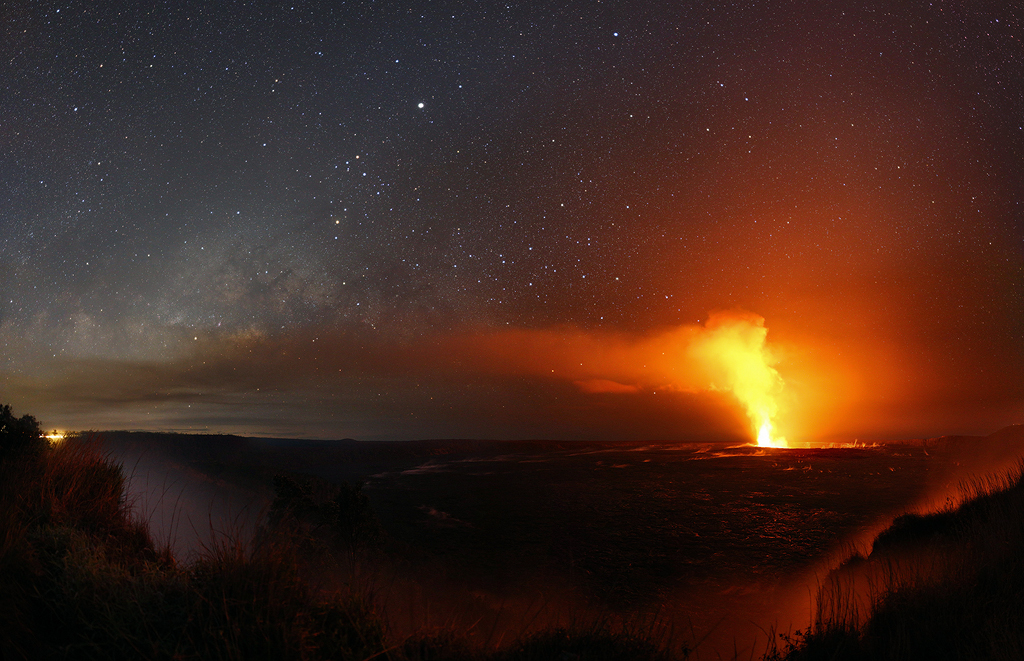
Volcanic activity on the Big Island of Hawaii has increased since this Hawaiian night skyscape was recorded earlier this year. Recent vents and lava flows are about 30 kilometers to the east, the direction of the blowing smoke and steam in the panoramic view of the Kilauea caldera with Halemaumau crater taken from Volcanoes National Park. Still, this year Jupiter is bright in late spring to early summer skies. High in the south it is easily the brightest celestial beacon in the scene where the central bulge of the Milky Way seems to rise above vapors and clouds. Yellowish Antares is the bright star near the end of the dark rivers of dust seen toward the center of our galaxy. Near the horizon, stars Alpha and Beta Centauri and the compact Southern Cross shine through the almost too bright volcanic smoke. via NASA https://ift.tt/2JaxfMv

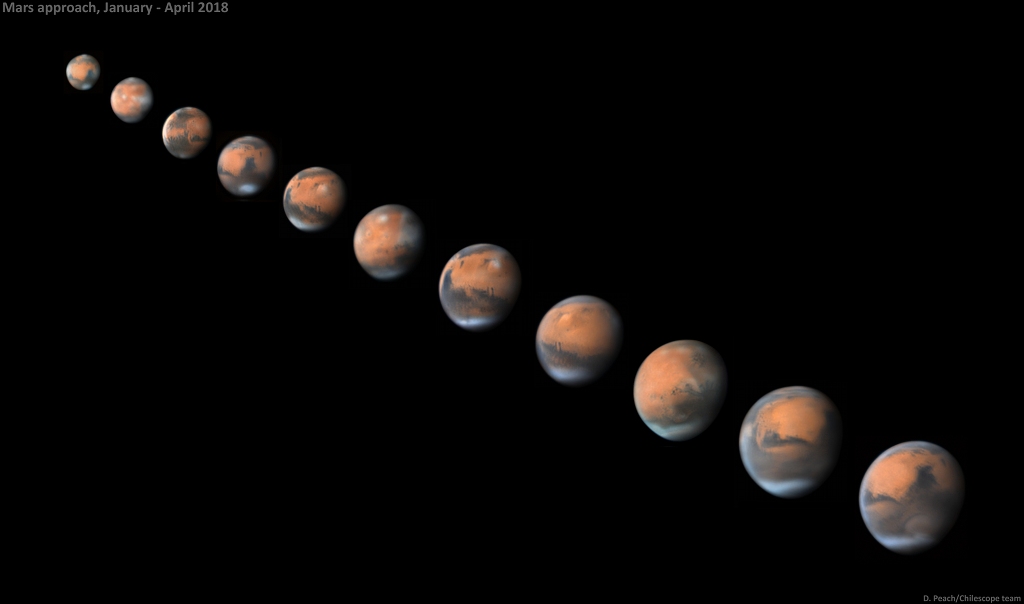
Mars Approach

Since the distance from Earth to Mars changes drastically as the planets orbit the Sun, Mars’ appearance changes dramaticaly. Mars is bright now, and it’s getting closer and brighter still as it orbits toward its 2018 opposition and closest approach to Earth in late July. This sequence of sharp telescopic images records the Red Planet’s steady increase in apparent size for the months of January (top left) through April. During that time its distance from Earth went from 284 million kilometers in January to 129 million kilometers in April, and so its apparent size more than doubled. At closest approach Mars will be about 58 million kilometers distant, more than doubling in apparent size compared to the disk at the lower right. By then it will rival the brightness of Jupiter in planet Earth’s night sky, but don’t believe the claims of the inevitable internet hoax. via NASA https://ift.tt/2xyLzgq

The Case of the Backwards Orbiting Asteroid

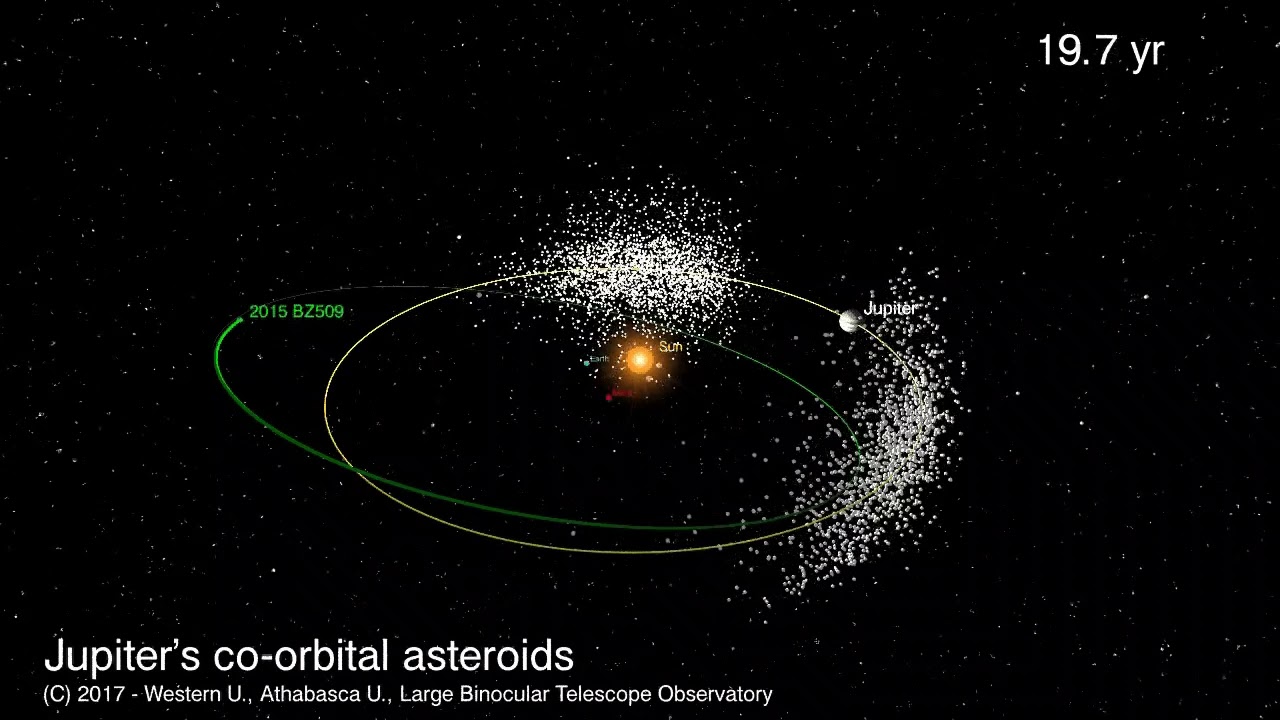
Why does asteroid 2015 BZ509 orbit the Sun the backwards? As shown in the featured animation, Jupiter’s trojan asteroids orbit the Sun in two major groups — one just ahead of Jupiter, and one just behind — but all orbit the Sun in the same direction as Jupiter. Asteroid BZ509 however, discovered in 2015 and currently unnamed, orbits the Sun in retrograde and in a more complex gravitational dance with Jupiter. The reason why is currently unknown and a topic of research — but if resolved might tell us about the early Solar System. A recently popular hypothesis holds that BZ509 was captured by Jupiter from interstellar space billions of years ago, while a competing conjecture posits that BZ509 came from our Solar System’s own distant Oort cloud of comets, perhaps more recently. The answer may only become known after more detailed models of the likelihood and stability of orbits near Jupiter are studied, or, possibly, by observing direct properties of the unusual object. via NASA https://ift.tt/2L64roZ

Aurora and Manicouagan Crater from the Space Station

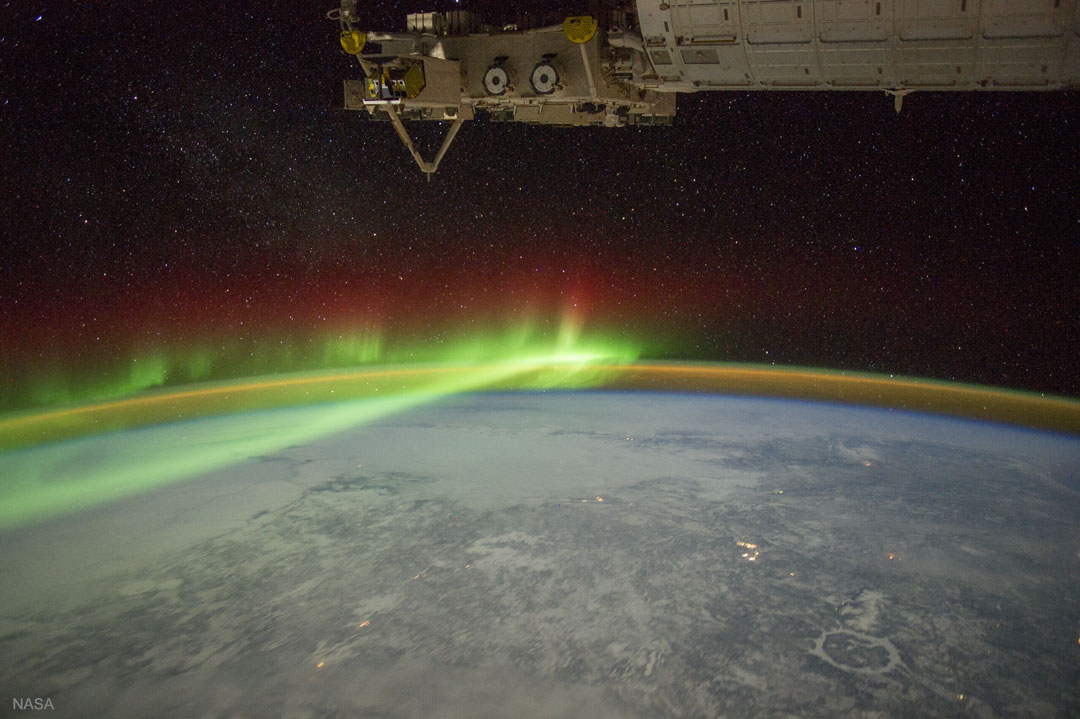
How many of these can you find in today’s featured photograph: an aurora, airglow, one of the oldest impact craters on the Earth, snow and ice, stars, city lights, and part of the International Space Station? Most of these can be identified by their distinctive colors. The aurora here appears green at the bottom, red at the top, and is visible across the left of image. Airglow appears orange and can be seen hovering over the curve of the Earth. The circular Manicouagan Crater in Canada, about 100 kilometers across and 200 million years old, is visible toward the lower right and is covered in white snow and ice. Stars, light in color, dot the dark background of space. City lights appear a bright yellow and dot the landscape. Finally, across the top, part of the International Space Station (ISS) appears mostly tan. The featured image was taken from the ISS in 2012. via NASA https://ift.tt/2GYClJV

Seven Dusty Sisters

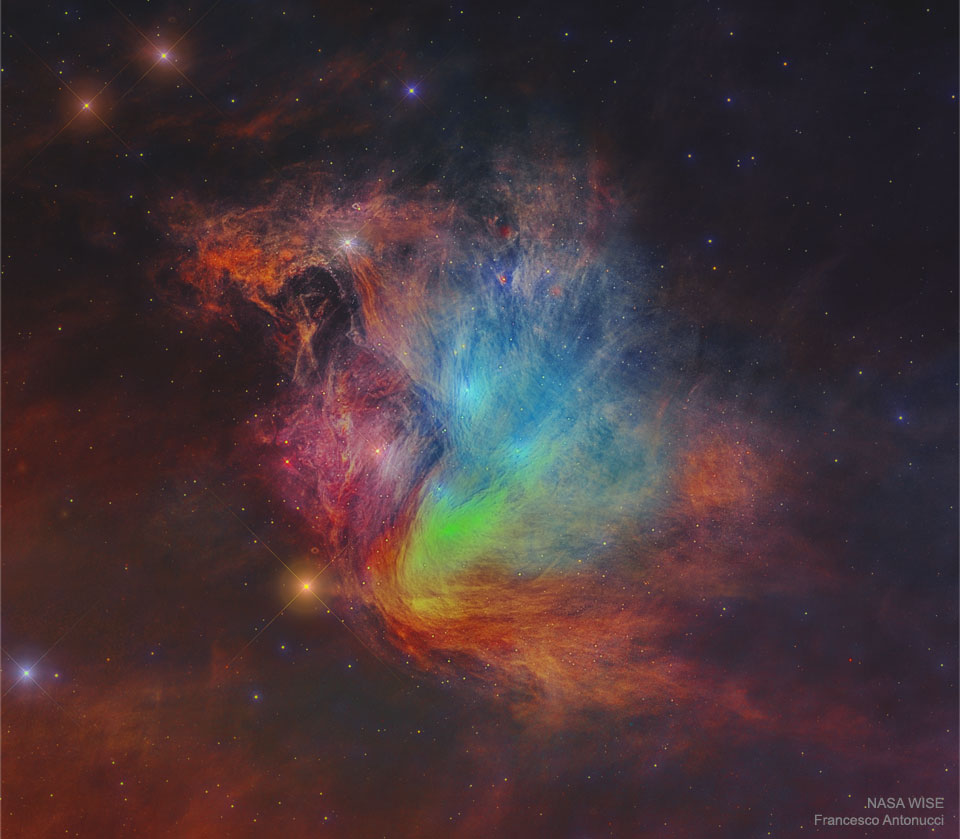
Is this really the famous Pleaides star cluster? Known for its iconic blue stars, the Pleaides is shown here in infrared light where the surrounding dust outshines the stars. Here three infrared colors have been mapped into visual colors (R=24, G=12, B=4.6 microns). The base images were taken by NASA’s orbiting Wide Field Infrared Survey Explorer (WISE) spacecraft. Cataloged as M45 and nicknamed the Seven Sisters, the Pleiades star cluster is by chance situated in a passing dust cloud. The light and winds from the massive Pleiades stars preferentially repels smaller dust particles, causing the dust to become stratified into filaments, as seen. The featured image spans about 20 light years at the distance of the Pleiades, which lies about 450 light years distant toward the constellation of the Bull (Taurus). via NASA https://ift.tt/2JdLNhB

Coronal Rain on the Sun

Does it rain on the Sun? Yes, although what falls is not water but extremely hot plasma. An example occurred in mid-July 2012 after an eruption on the Sun that produced both a Coronal Mass Ejection and a moderate solar flare. What was more unusual, however, was what happened next. Plasma in the nearby solar corona was imaged cooling and falling back, a phenomenon known as coronal rain. Because they are electrically charged, electrons, protons, and ions in the rain were gracefully channeled along existing magnetic loops near the Sun’s surface, making the scene appear as a surreal three-dimensional sourceless waterfall. The resulting surprisingly-serene spectacle is shown in ultraviolet light and highlights matter glowing at a temperature of about 50,000 Kelvin. Each second in the featured time lapse video takes about 6 minutes in real time, so that the entire coronal rain sequence lasted about 10 hours. Recent observations have confirmed that that coronal rain can also occur in smaller loops for as long as 30 hours. via NASA https://ift.tt/2KZNNHD

Titan: Moon over Saturn

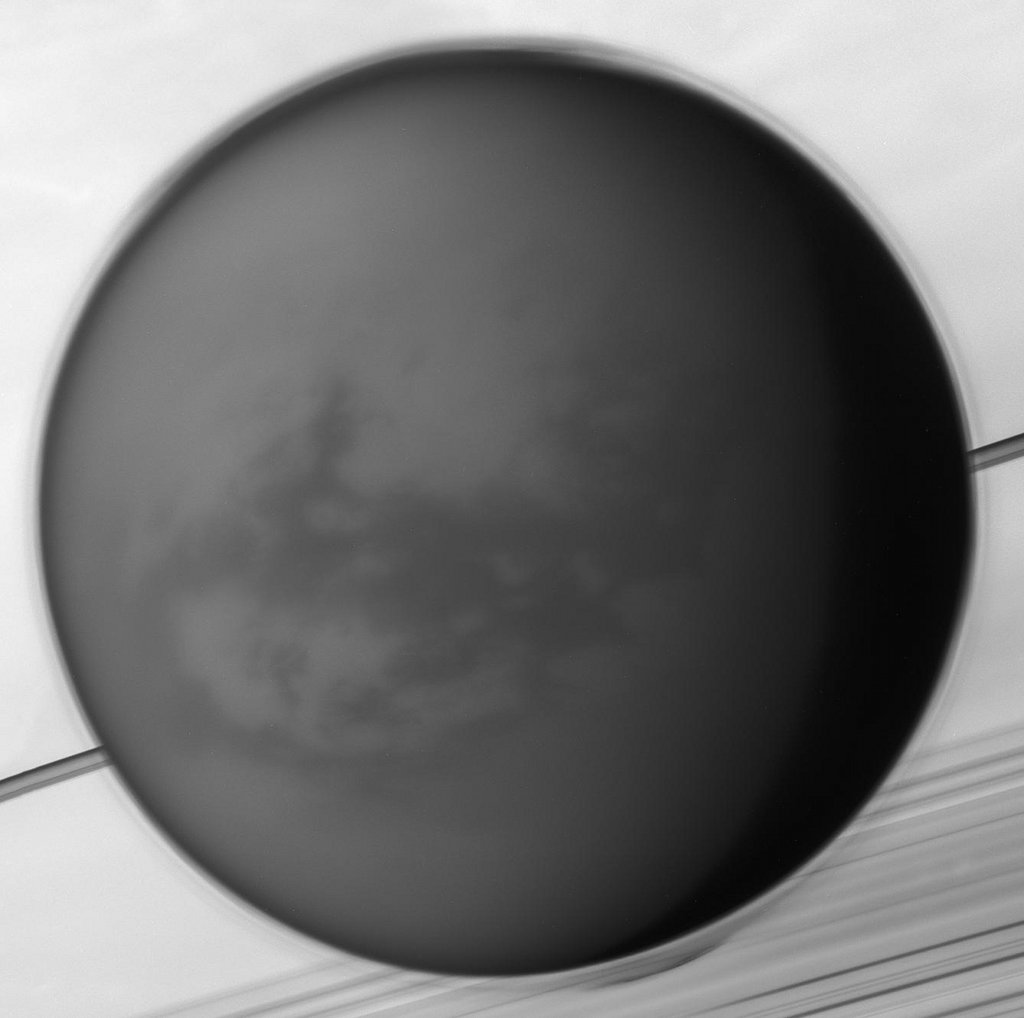
Like Earth’s moon, Saturn’s largest moon Titan is locked in synchronous rotation. This mosiac of images recorded by the Cassini spacecraft in May of 2012 show’s its anti-Saturn side, the side always facing away from the ringed gas giant. The only moon in the solar system with a dense atmosphere, Titan is the only solar system world besides Earth known to have standing bodies of liquid on its surface and an earthlike cycle of liquid rain and evaporation. Its high altitude layer of atmospheric haze is evident in the Cassini view of the 5,000 kilometer diameter moon over Saturn’s rings and cloud tops. Near center is the dark dune-filled region known as Shangri-La. The Cassini-delivered Huygens probe rests below and left of center, after the most distant landing for a spacecraft from Earth. via NASA https://ift.tt/2ksOcXU

Galaxies Away

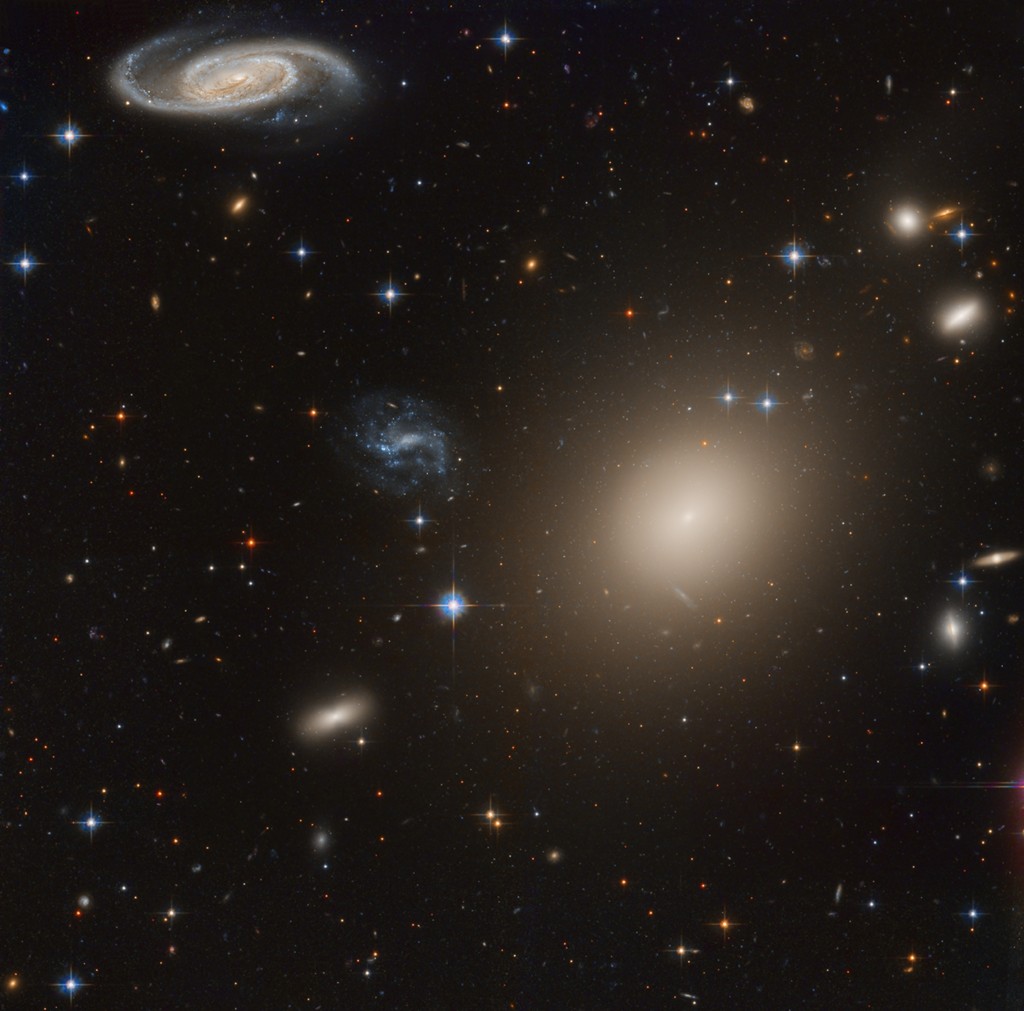
This stunning group of galaxies is far, far away, about 450 million light-years from planet Earth and cataloged as galaxy cluster Abell S0740. Dominated by the cluster’s large central elliptical galaxy (ESO 325-G004), this reprocessed Hubble Space Telescope view takes in a remarkable assortment of galaxy shapes and sizes with only a few spiky foreground stars scattered through the field. The giant elliptical galaxy (right of center) spans over 100,000 light years and contains about 100 billion stars, comparable in size to our own spiral Milky Way galaxy. The Hubble data can reveal a wealth of detail in even these distant galaxies, including arms and dust lanes, star clusters, ring structures, and gravitational lensing arcs. via NASA https://ift.tt/2IKtSQj

The Gum Nebula Expanse

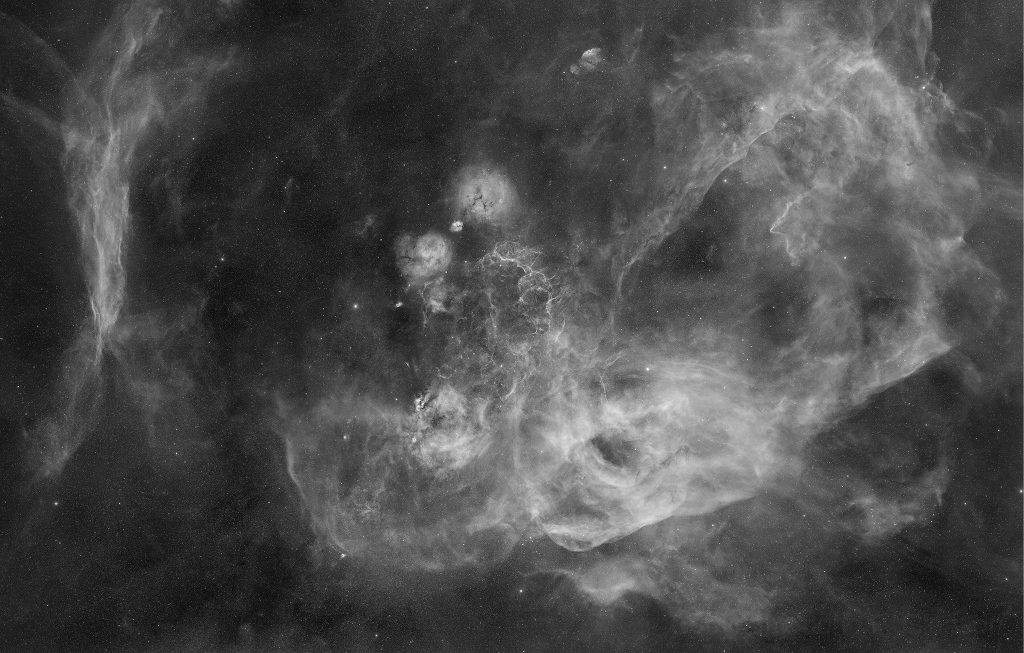
Named for a cosmic cloud hunter, Australian astronomer Colin Stanley Gum (1924-1960), The Gum Nebula is so large and close it is actually hard to see. In fact, we are only about 450 light-years from the front edge and 1,500 light-years from the back edge of this interstellar expanse of glowing hydrogen gas. Covered in this 40+ degree-wide monochrome mosaic of Hydrogen-alpha images, the faint emission region stands out against the background of Milky Way stars. The complex nebula is thought to be a supernova remnant over a million years old, sprawling across the Ship’s southern constellations Vela and Puppis. This spectacular wide field view also explores many objects embedded in The Gum Nebula, including the younger Vela supernova remnant. via NASA https://ift.tt/2J8zOBM