Planet of the Tajinastes

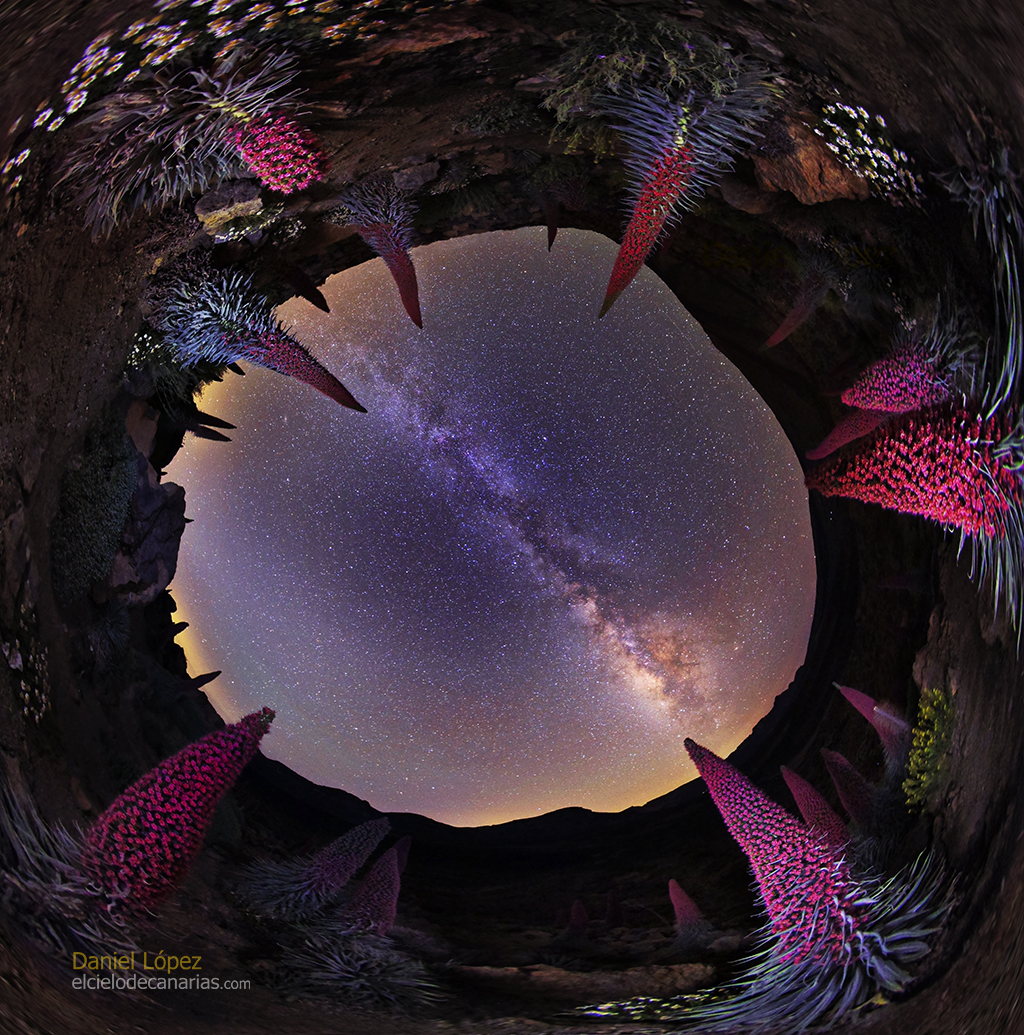
What bizarre planet are these alien creatures from? It’s only planet Earth, of course. The planet’s home galaxy the Milky Way stretches across a dark sky in the panoramic, fisheye all-sky projection composed with a wide lens. But the imposing forms gazing skyward probably look strange to many denizens of Earth. Found on the Canary Island of Tenerife in the Teide National Park, they are red tajinastes, flowering plants that grow to a height of up to 3 meters. Among the rocks of the volcanic terrain, tajinastes bloom in spring and early summer and then die after a week or so as their seeds mature. A species known as Echium wildpretii, the terrestrial life forms were individually lit by flashlight during the wide-angle exposures. via NASA https://go.nasa.gov/2YQd9ia

Boulders on Bennu

An abundance of boulders litters the surface asteroid 101955 Bennu in this dramatic close-up from the OSIRIS-REx spacecraft. Taken on March 28 from a distance of just 3.4 kilometers (2.1 miles) the field of view is about 50 meters across while the light colored boulder at top right is 4.8 meters tall. Likely a loose conglomerate rubble pile asteroid, Bennu itself spans less than 500 meters. That’s about the height of the Empire State Building. Mapping the near Earth asteroid since the spacecraft’s arrival in December of 2018, the OSIRIS-REx mission plans a TAG (Touch-and-Go) maneuver for July 2020 to sample Bennu’s rugged surface, returning the sample to planet Earth in September 2023. Citizen scientists have been invited to help choose the sample collection site. via NASA https://go.nasa.gov/2YOacyC

Moons Near Jupiter

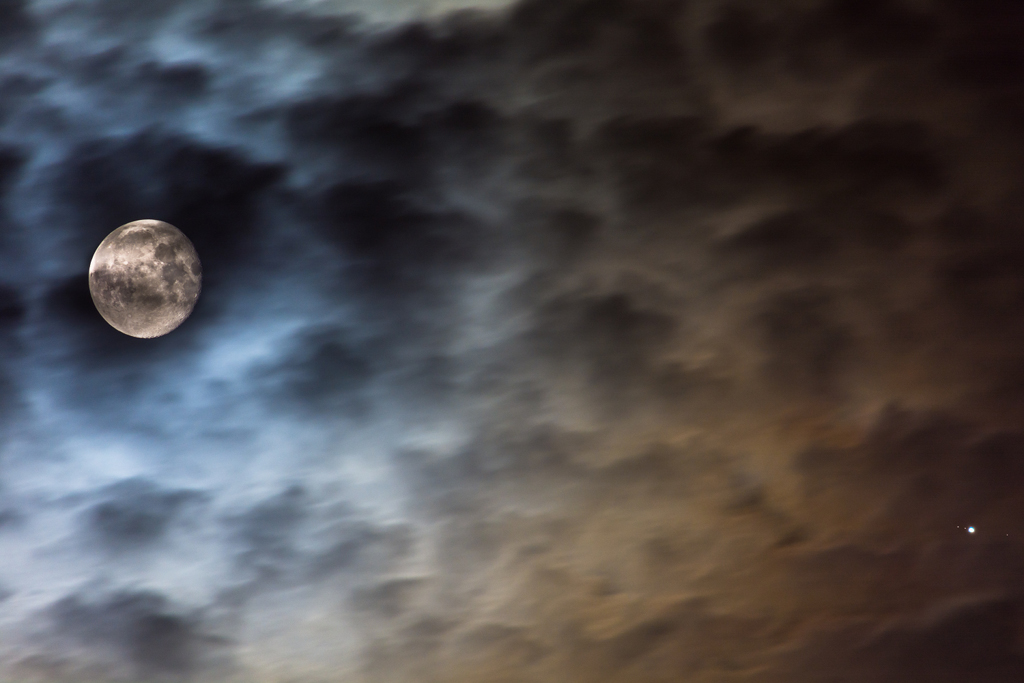
On May 20, a nearly Full Moon and Jupiter shared this telephoto field of view. Captured when a passing cloud bank dimmed the moonlight, the single exposure reveals the familiar face of our fair planet’s own large natural satellite, along with bright Jupiter (lower right) and some of its Galilean moons. Lined up left to right the tiny pinpricks of light near Jupiter are Ganymede, Europa, [Jupiter] and Callisto. (That’s not just dust on your screen …) Closer and brighter, our own natural satellite appears to loom large. But Ganymede, and Callisto are physically larger than Earth’s Moon, while water world Europa is only slightly smaller. In fact, of the Solar System’s six largest planetary satellites, Saturn’s moon Titan is missing from the scene and a fourth Galilean moon, Io, is hidden by our ruling gas giant. via NASA https://go.nasa.gov/2EpUn9k

Planets of the Solar System: Tilts and Spins

How does your favorite planet spin? Does it spin rapidly around a nearly vertical axis, or horizontally, or backwards? The featured video animates NASA images of all eight planets in our Solar System to show them spinning side-by-side for an easy comparison. In the time-lapse video, a day on Earth — one Earth rotation — takes just a few seconds. Jupiter rotates the fastest, while Venus spins not only the slowest (can you see it?), but backwards. The inner rocky planets, across the top, most certainly underwent dramatic spin-altering collisions during the early days of the Solar System. The reasons why planets spin and tilt as they do remains a topic of research with much insight gained from modern computer modeling and the recent discovery and analysis of hundreds of exoplanets: planets orbiting other stars. via NASA https://go.nasa.gov/30uLuEZ

Atlas, Daphnis, and Pan

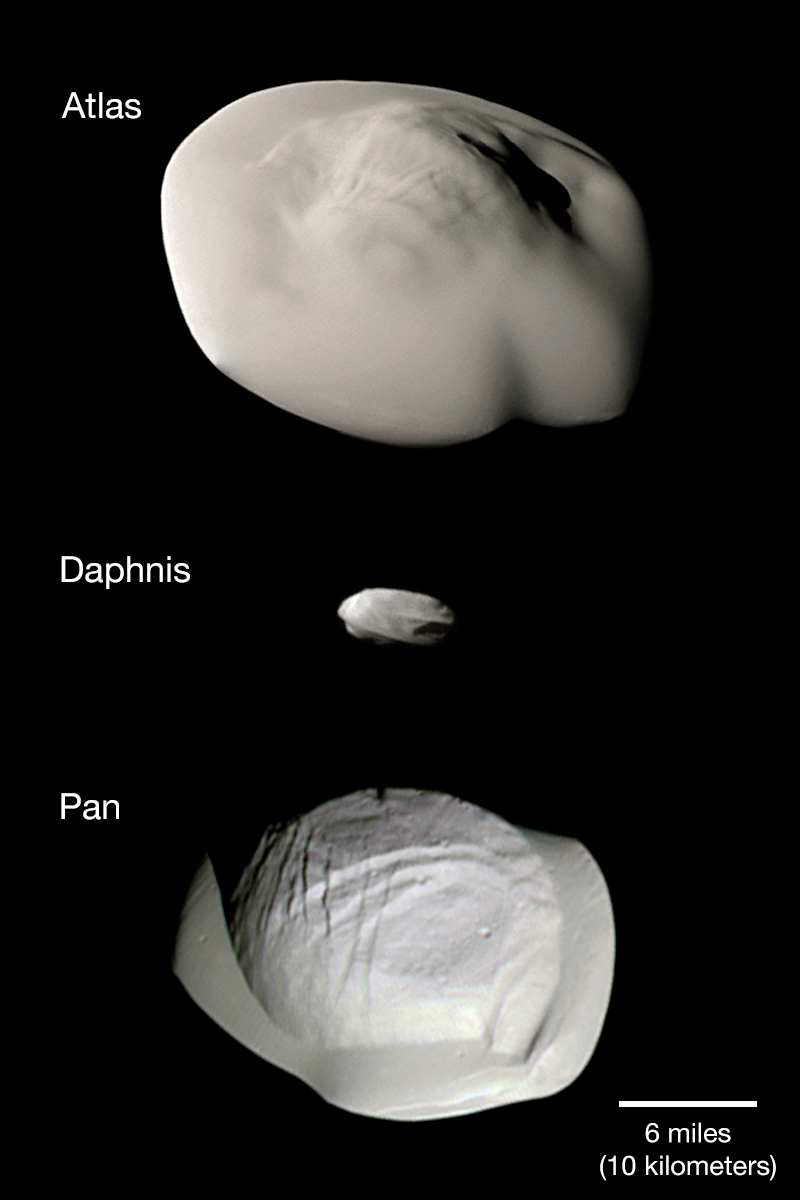
Atlas, Daphnis, and Pan are small, inner, ring moons of Saturn. They are shown at the same scale in this montage of images by the Cassini spacecraft that made its grand final orbit of the ringed planet in September 2017. In fact, Daphnis was discovered in Cassini images from 2005. Atlas and Pan were first sighted in images from the Voyager 1 and 2 spacecraft. Flying saucer-shaped Atlas orbits near the outer edge of Saturn’s bright A Ring while Daphnis orbits inside the A Ring’s narrow Keeler Gap and Pan within the A Ring’s larger Encke Gap. The curious equatorial ridges of the small ring moons could be built up by the accumulation of ring material over time. Even diminutive Daphnis makes waves in the ring material as it glides along the edge of the Keeler Gap. via NASA https://go.nasa.gov/2JqRWHK

RS Puppis

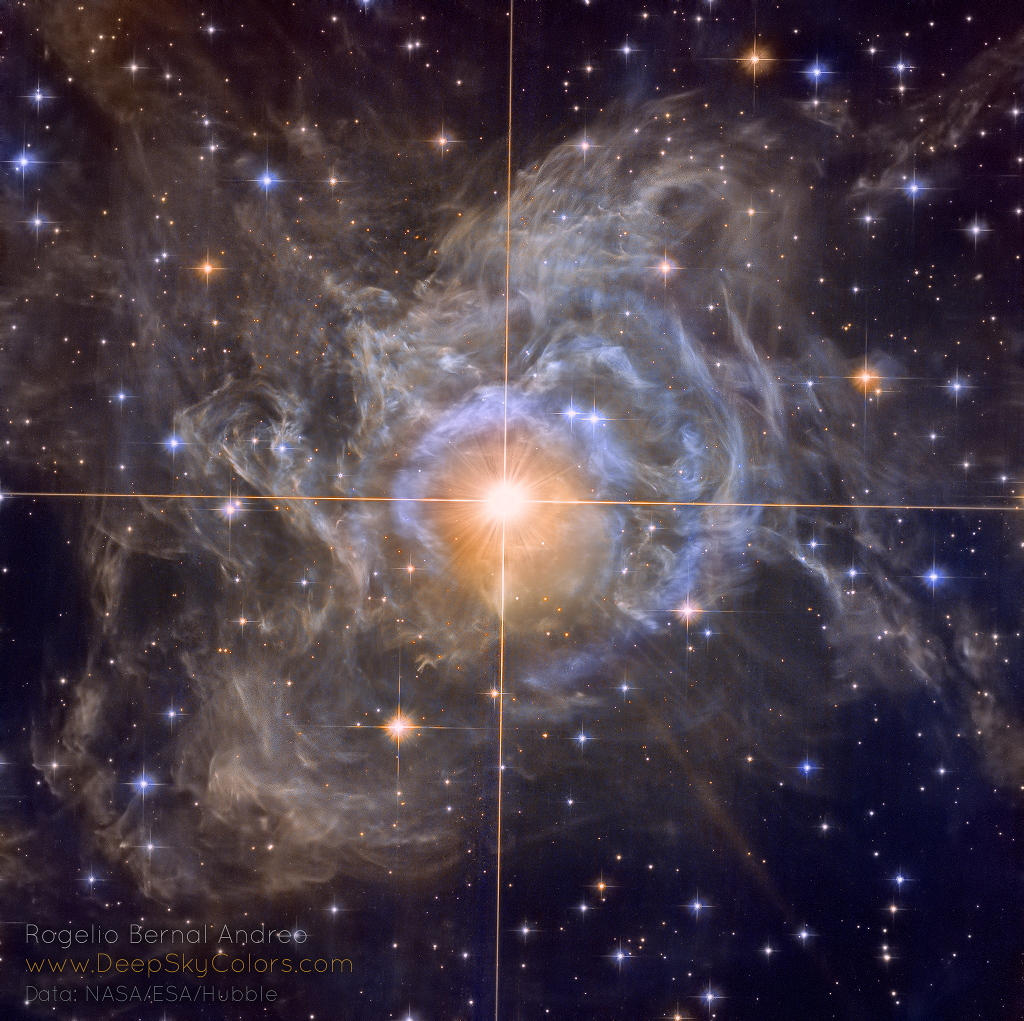
Pulsating RS Puppis, the brightest star in the image center, is some ten times more massive than our Sun and on average 15,000 times more luminous. In fact, RS Pup is a Cepheid variable star, a class of stars whose brightness is used to estimate distances to nearby galaxies as one of the first steps in establishing the cosmic distance scale. As RS Pup pulsates over a period of about 40 days, its regular changes in brightness are also seen along its surrounding nebula delayed in time, effectively a light echo. Using measurements of the time delay and angular size of the nebula, the known speed of light allows astronomers to geometrically determine the distance to RS Pup to be 6,500 light-years, with a remarkably small error of plus or minus 90 light-years. An impressive achievement for stellar astronomy, the echo-measured distance also more accurately establishes the true brightness of RS Pup, and by extension other Cepheid stars, improving the knowledge of distances to galaxies beyond the Milky Way. via NASA https://go.nasa.gov/2VGw7us

Dark Skies: Turn on the Night

Have you ever experienced a really dark night sky? One common and amazing feature is the glowing band of our Milky Way galaxy stretching from horizon to horizon. If you live in or near a big city, though, you might not know this because city lights reflecting off the Earth’s atmosphere could only allow you to see the Moon and a few stars. Today, however, being UNESCO’s International Day of Light, the International Astronomical Union is asking people to Turn on the Night by trying to better understand, and in the future better reduce, light pollution. You can practice even now by going to the main APOD website at NASA and hovering your cursor over the Before image. The After picture that comes up is a panorama of four exposures taken with the same camera and from the same location, showing what happened recently in China when people in Kaihua County decided to turn down many of their lights. Visible in the Before picture are the stars Sirius (left of center) and Betelgeuse, while visible in the After picture are thousands of stars with the arching band of our Milky Way Galaxy. Humanity has lived for millennia under a dark night sky, and connecting to it has importance for both natural and cultural heritage. via NASA https://go.nasa.gov/2WP64hc

Anemic Spiral NGC 4921 from Hubble

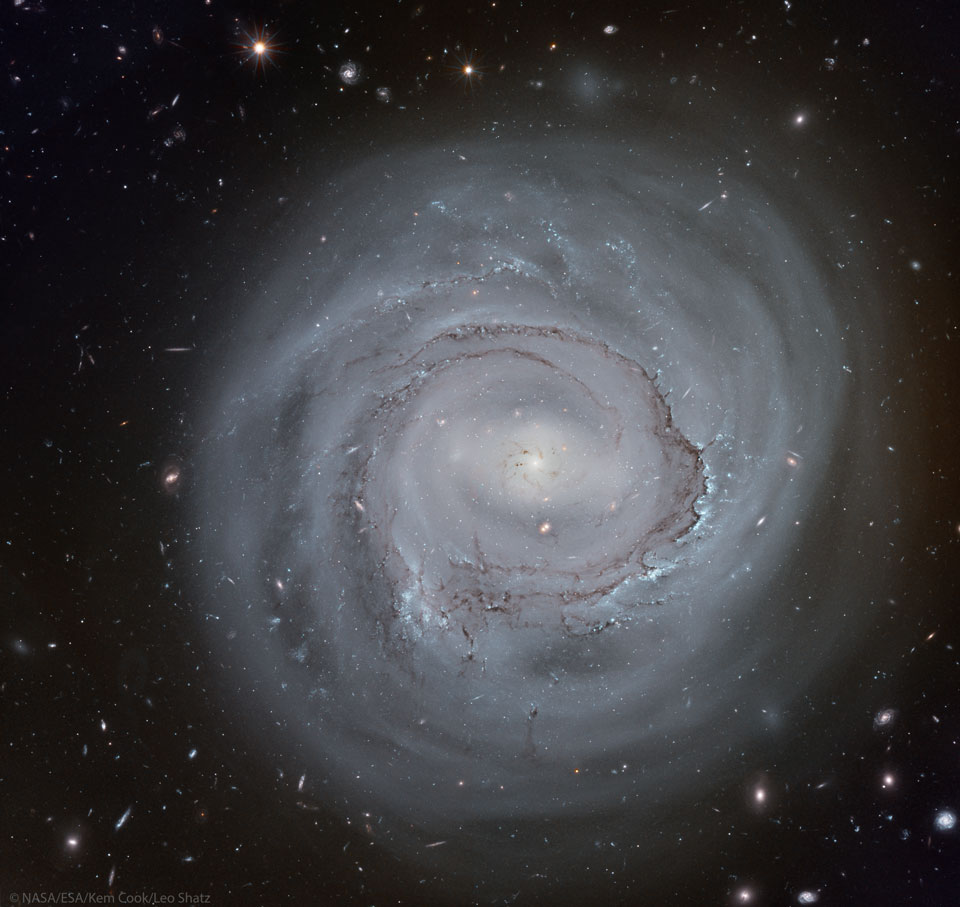
How far away is spiral galaxy NGC 4921? It’s surpringly important to know. Although presently estimated to be about 300 million light years distant, a more precise determination could be coupled with its known recession speed to help humanity better calibrate the expansion rate of the entire visible universe. Toward this goal, several images were taken by the Hubble Space Telescope in order to help identify key stellar distance markers known as Cepheid variable stars. Since NGC 4921 is a member of the Coma Cluster of Galaxies, refining its distance would also allow a better distance determination to one of the largest nearby clusters in the local universe. The magnificent spiral NGC 4921 has been informally dubbed anemic because of its low rate of star formation and low surface brightness. Visible in the featured image are, from the center, a bright nucleus, a bright central bar, a prominent ring of dark dust, blue clusters of recently formed stars, several smaller companion galaxies, unrelated galaxies in the far distant universe, and unrelated stars in our Milky Way Galaxy. via NASA https://go.nasa.gov/2WDF8Rj