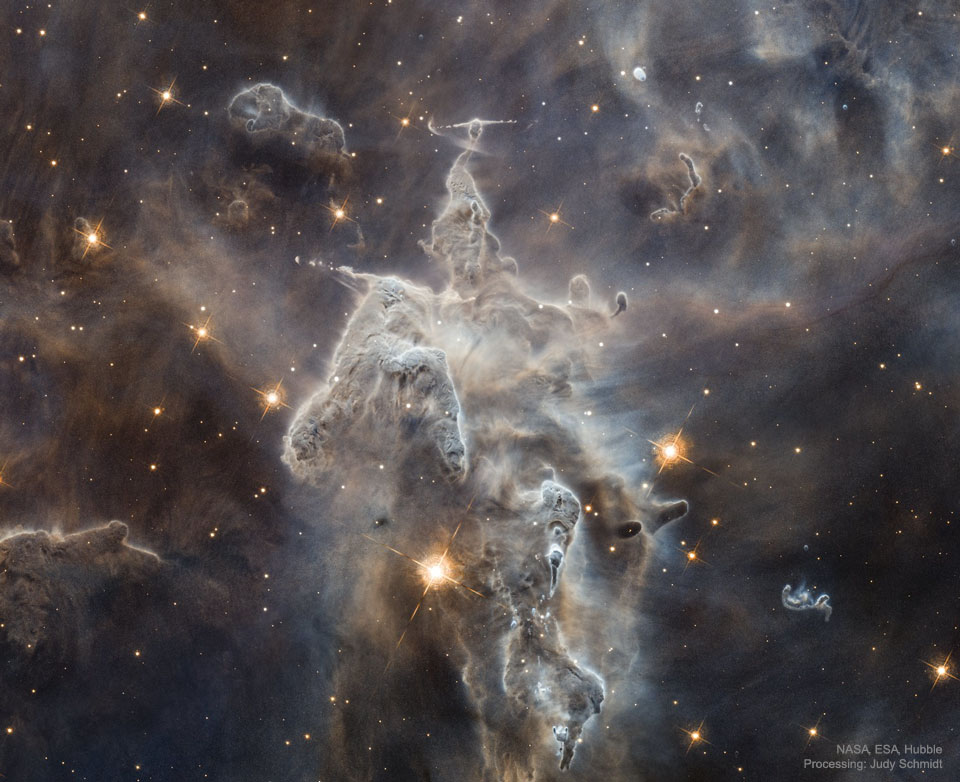
Mystic Mountain Monster being Destroyed

Inside the head of this interstellar monster is a star that is slowly destroying it. The huge monster, actually an inanimate series of pillars of gas and dust, measures light years in length. The in-head star is not itself visible through the opaque interstellar dust but is bursting out partly by ejecting opposing beams of energetic particles called Herbig-Haro jets. Located about 7,500 light years away in the Carina Nebula and known informally as Mystic Mountain, the appearance of these pillars is dominated by dark dust even though they are composed mostly of clear hydrogen gas. The featured image was taken with the Hubble Space Telescope. All over these pillars, the energetic light and winds from massive newly formed stars are evaporating and dispersing the dusty stellar nurseries in which they formed. Within a few million years, the head of this giant, as well as most of its body, will have been completely evaporated by internal and surrounding stars. via NASA https://ift.tt/3egznkQ
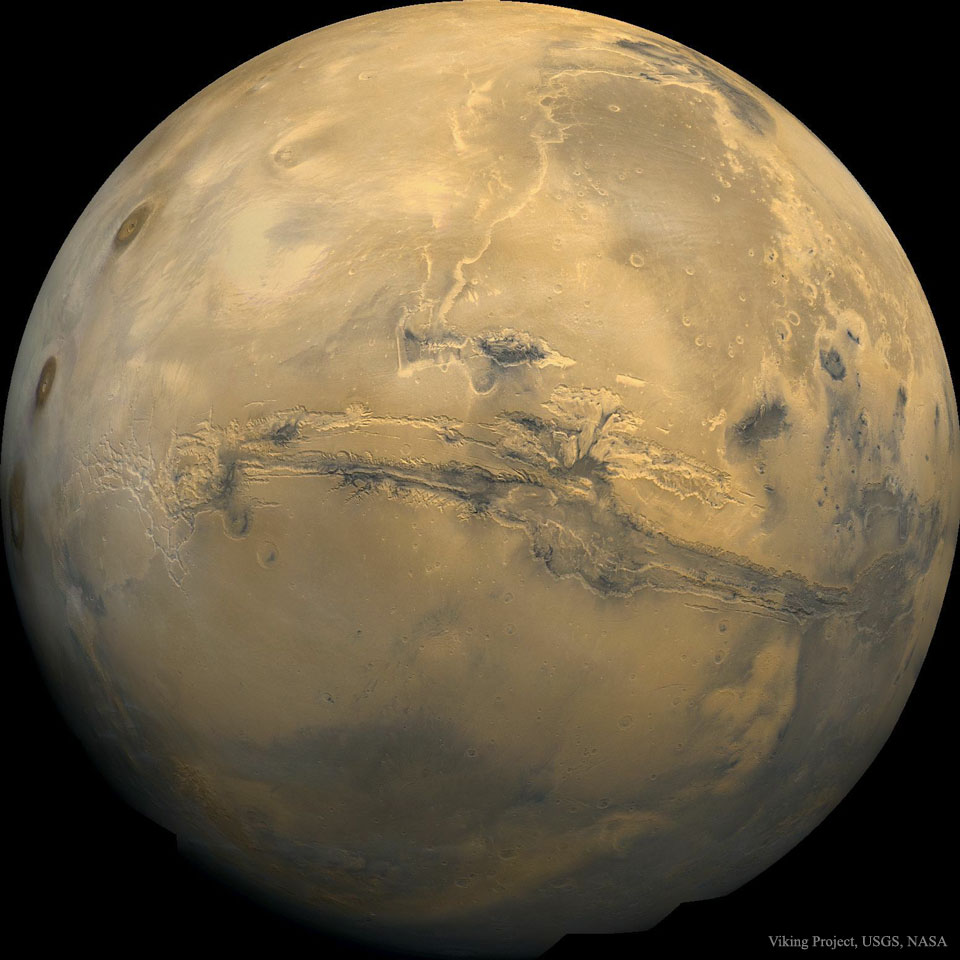
Valles Marineris: The Grand Canyon of Mars

The largest canyon in the Solar System cuts a wide swath across the face of Mars. Named Valles Marineris, the grand valley extends over 3,000 kilometers long, spans as much as 600 kilometers across, and delves as much as 8 kilometers deep. By comparison, the Earth’s Grand Canyon in Arizona, USA is 800 kilometers long, 30 kilometers across, and 1.8 kilometers deep. The origin of the Valles Marineris remains unknown, although a leading hypothesis holds that it started as a crack billions of years ago as the planet cooled. Several geologic processes have been identified in the canyon. The featured mosaic was created from over 100 images of Mars taken by Viking Orbiters in the 1970s. via NASA https://ift.tt/2XvsDJo

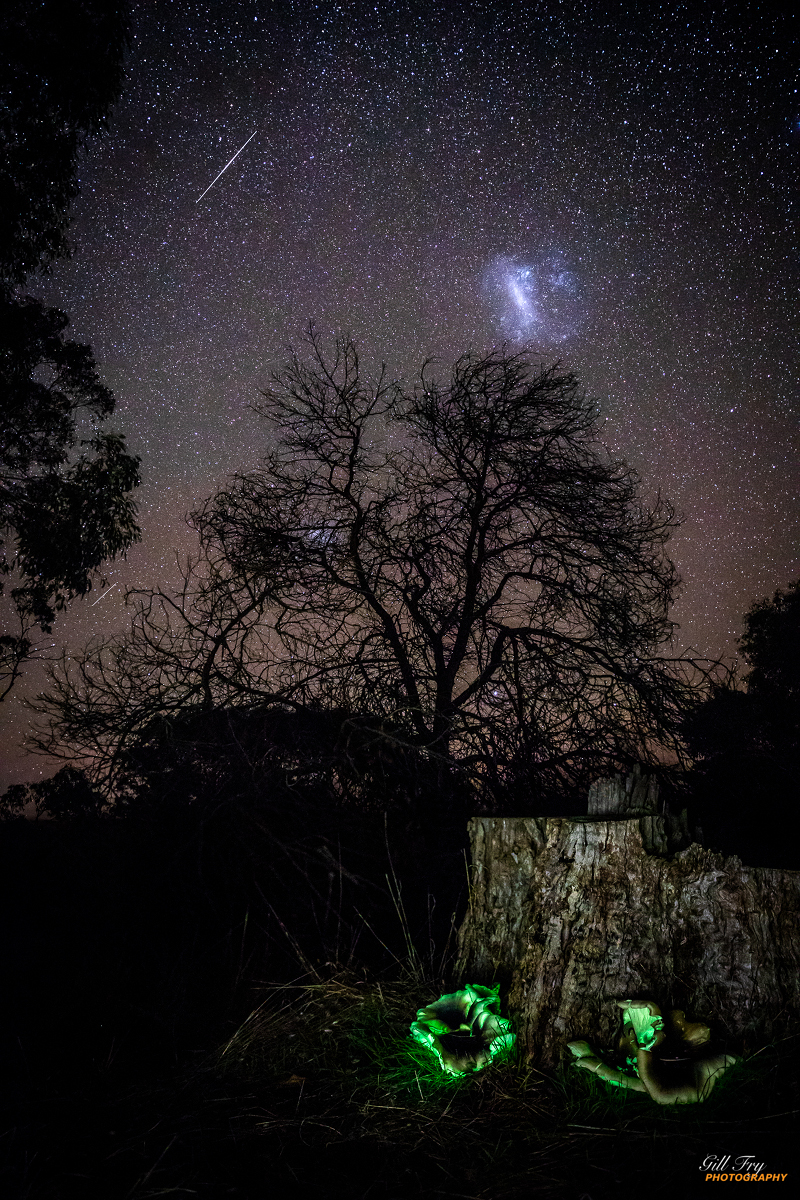
Ghost Fungus to Magellanic Cloud

Stars shine and satellites glint in this clear, dark, night sky over Wannon Falls Reserve, South West Victoria, Australia. In fact the fuzzy, faint apparition above the tree tops is the only cloud visible, also known as the Large Magellanic Cloud, satellite galaxy of our own Milky Way. In the foreground, an Omphalotus nidiformis (ghost fungus) from planet Earth shines with a surprisingly bright bioluminescence. Like the Magellanic cloud, the ghost fungus was easily seen with the eye. Its ghostly glow was actually a dull green, but it appears bright green in digital camera picture. Two images were blended to create the scene. One focused on the distant stars and Large Magellanic Cloud some 160,000 light-years away. Another was focused on the foreground and glowing fungus several light-nanoseconds from the camera lens. via NASA https://ift.tt/36oQqOS

South of Carina

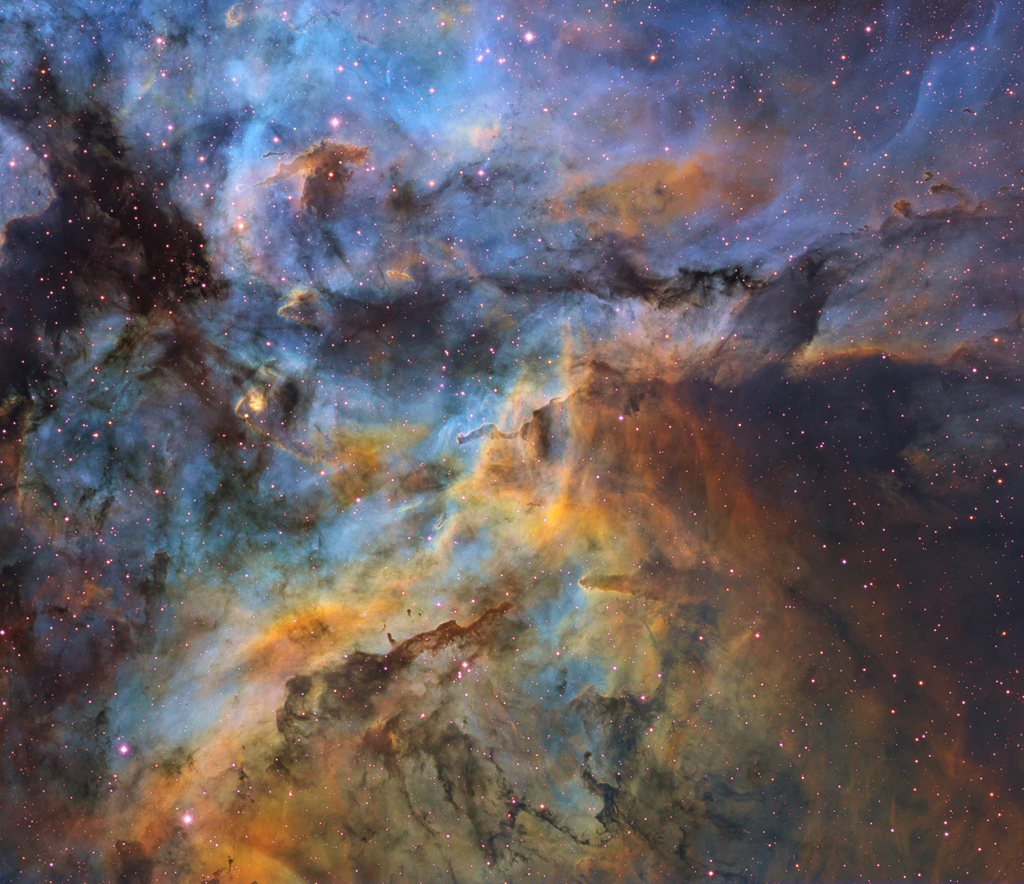
With natal dust clouds in silhouette against glowing atomic gas, this colorful and chaotic vista lies within one of the largest star forming regions in the Milky Way galaxy, the Great Carina Nebula. The telescopic close-up frames a field of view about 80 light-years across, a little south and east of Eta Carinae, the nebula’s most energetic and enigmatic star. Captured under suburban skies improved during national restrictions, a composite of narrowband image data was used to create the final image. In it, characteristic emission from the nebula’s ionized sulfur, hydrogen, and oxygen atoms is mapped to red, green, and blue hues, a color palette also popular in Hubble Space Telescope images. The celestial landscape of bright ridges of emission bordered by cool, obscuring dust lies about 7,500 light-years away toward the southern constellation Carina. via NASA https://ift.tt/2zn5G2J

Phases of Venus

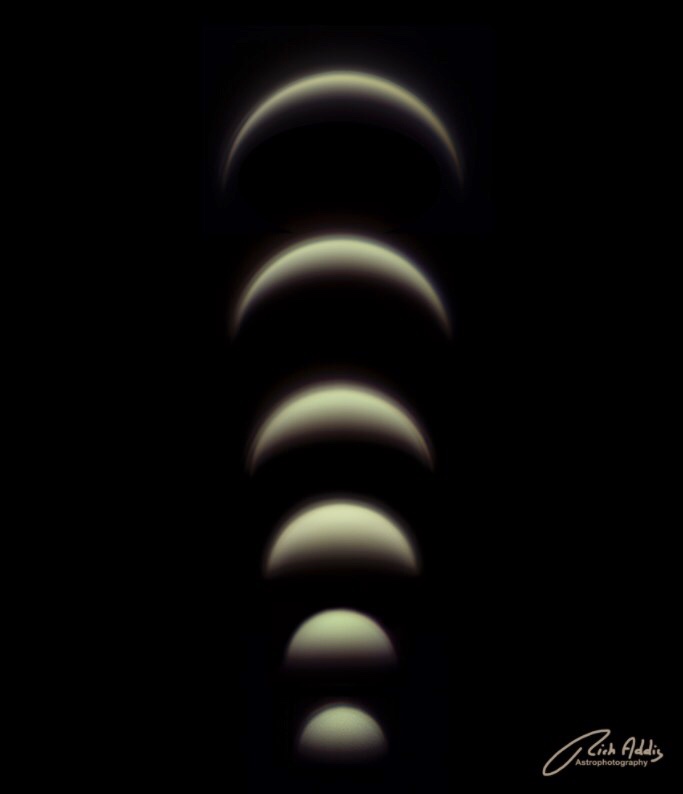
Just as the Moon goes through phases, Venus’ visible sunlit hemisphere waxes and wanes. This composite of backyard telescopic images illustrates the steady changes for Venus during its current stint as our evening star, as the inner planet grows larger but narrows to a thin crescent. Images from bottom to top were taken during 2020 on dates February 27, March 20, April 14, April 24, May 8, and May 14. Gliding along its interior orbit between Earth and Sun, Venus grows larger during that period because it is approaching planet Earth. Its crescent narrows, though, as Venus swings closer to our line-of-sight to the Sun. Closest to the Earth-Sun line but passing about 1/2 degree north of the Sun on June 3, Venus will reach a (non-judgmental) inferior conjunction. Soon after, Venus will shine clearly above the eastern horizon in predawn skies as planet Earth’s morning star. After sunset tonight look for Venus above the western horizon and you can also spot elusive innermost planet Mercury. via NASA https://ift.tt/2TqBnPt

Moon, Mars, Saturn, Jupiter, Milk Way

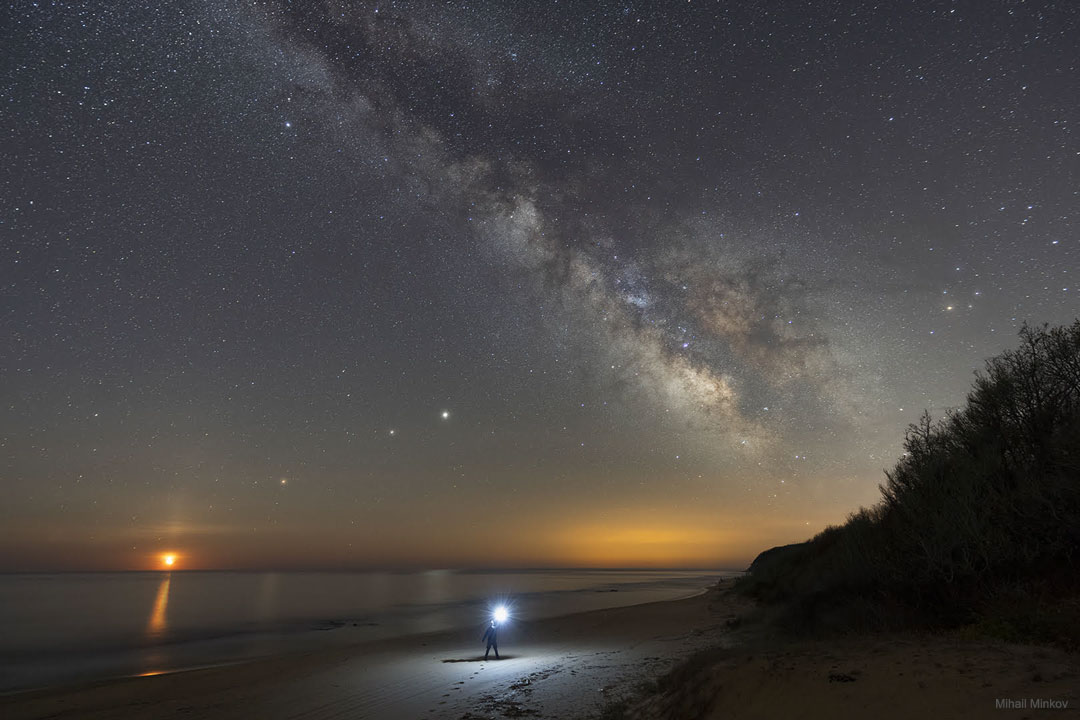
It is not a coincidence that planets line up. That’s because all of the planets orbit the Sun in (nearly) a single sheet called the plane of the ecliptic. When viewed from inside that plane — as Earth dwellers are likely to do — the planets all appear confined to a single band. It is a coincidence, though, when three of the brightest planets all appear in nearly the same direction. Such a coincidence was captured about a month ago. Featured above, Earth’s Moon, Mars, Saturn, and Jupiter were all imaged together, just before sunrise, from the Black Sea coast of Bulgaria. A second band is visible diagonally across this image — the central band of our Milky Way Galaxy. If you wake up early, you will find that these same planets remain visible in the morning sky this month, too. via NASA https://ift.tt/2ymUp28

Posters of the Solar System

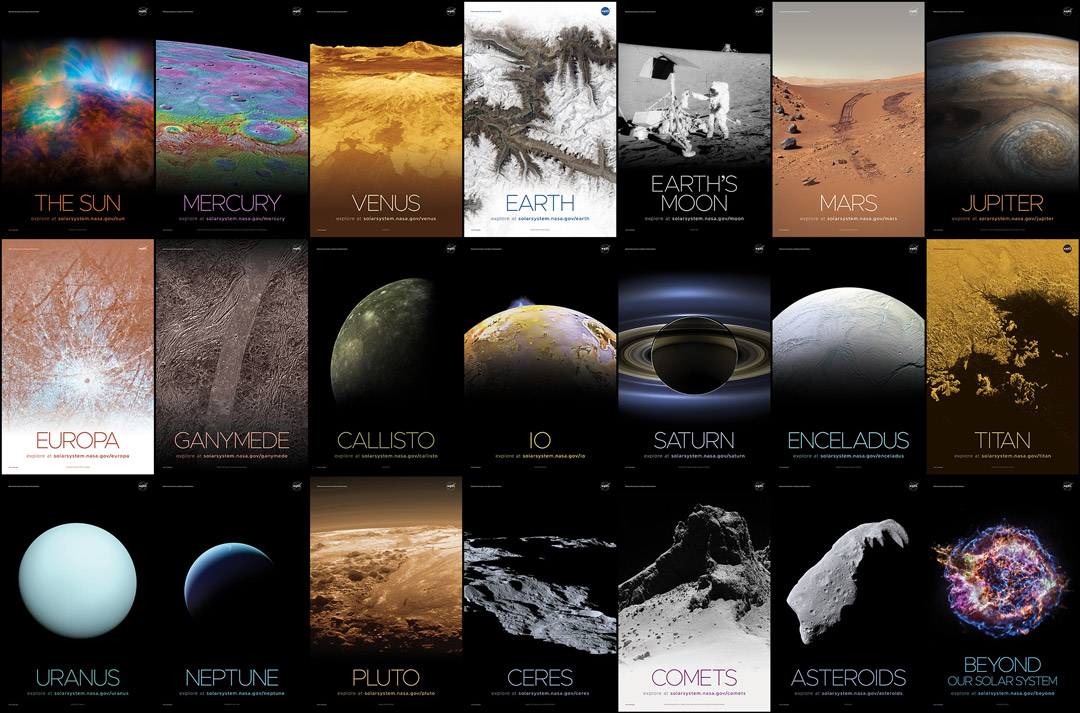
Would you like a NASA astronomy-exploration poster? You are just one page-print away. Any of the panels you see on the featured image can appear on your wall. Moreover, this NASA page has, typically, several more posters of each of the Solar System objects depicted. These posters highlight many of the places humanity, through NASA, has explored in the past 50 years, including our Sun, and planets Mercury, Venus, Earth, Mars, Jupiter, Saturn, Uranus, and Neptune. Moons of Jupiter that have been posterized include Europe, Ganymede, Callisto, and Io, while moons of Saturn that can be framed include Enceladus and Titan. Images of Pluto, Ceres, comets and asteroids are also presented, while six deep space scenes — well beyond our Solar System — can also be prominently displayed. If you lack wall space or blank poster sheets don’t despair — you can still print many of these out as trading cards. via NASA https://ift.tt/2z9Dj8b

Journey into the Cosmic Reef

What would you see if you could fly into the Cosmic Reef? The nebular cloud NGC 2014 appear to some like an ocean reef that resides in the sky, specifically in the LMC, the largest satellite galaxy of our Milky Way Galaxy. A detailed image of this distant nebula was taken by the Hubble Space Telescope to help commemorate 30 years of investigating the cosmos. Data and images of this cosmic reef have been combined into the three-dimensional model flown through in the featured video. The computer animated sequence first takes you past a star cluster highlighted by bright blue stars, below pillars of gas and dust slowly being destroyed by the energetic light and winds emitted by these massive stars. Filaments of gas and dust are everywhere, glowing in the red light of hydrogen and nitrogen. The animation next takes you to the blue-colored nebula NGC 2020, glowing in light emitted by oxygen and surrounding a Wolf-Rayet star about 200,000 times brighter than our Sun — a nebula thought to be the ejected outer atmosphere of this stellar monster. As the animation concludes, the virtual camera pivots to show that NGC 2020 has a familiar hourglass shape when viewed from the side. via NASA https://ift.tt/36bcaxz

A Waterspout in Florida

What’s happening over the water? Pictured here is one of the better images yet recorded of a waterspout, a type of tornado that occurs over water. Waterspouts are spinning columns of rising moist air that typically form over warm water. Waterspouts can be as dangerous as tornadoes and can feature wind speeds over 200 kilometers per hour. Some waterspouts form away from thunderstorms and even during relatively fair weather. Waterspouts may be relatively transparent and initially visible only by an unusual pattern they create on the water. The featured image was taken in 2013 July near Tampa Bay, Florida. The Atlantic Ocean off the coast of Florida is arguably the most active area in the world for waterspouts, with hundreds forming each year. via NASA https://ift.tt/2LCcaxs

The Dark River to Antares

A dark river seems to flow through this sky from the horizon toward colorful clouds near red giant star Antares. Murky looking, the dark river is a dusty nebula obscuring background starlight near the central Milky Way, although the dark dust nebula contains mostly hydrogen molecular gas. Dust scattering starlight around Antares, alpha star of Scorpius, creates the unusual yellow-hued reflection nebula. Above it, bright blue double star Rho Ophiuchi is embedded in more typical dusty bluish reflection nebulae, with red emission nebulae also scattered through the interstellar space. Globular star cluster M4 looks almost like a bright star just above and right of Antares, though it lies far behind the colorful clouds, at a distance of some 7,000 light-years. The dark river itself is about 500 light years away. To create the startling night sky view, all background and foreground exposures were made back to back with the same camera and telephoto lens on the same night from the same location. In combination they produce a stunning image that reveals a range of brightness and color that your eye can’t quite perceive. Recorded in the early hours of January 31, the composite also captures Mars still near the eastern horizon and rising to join rival Antares on the celestial stage. Bright Mars and its watery reflection are left of a lonely tree in the Bosque del Apache National Wildlife Refuge, New Mexico, planet Earth. via NASA https://ift.tt/3fSo97V