Archives de catégorie : Image

One Night One Telescope One Camera

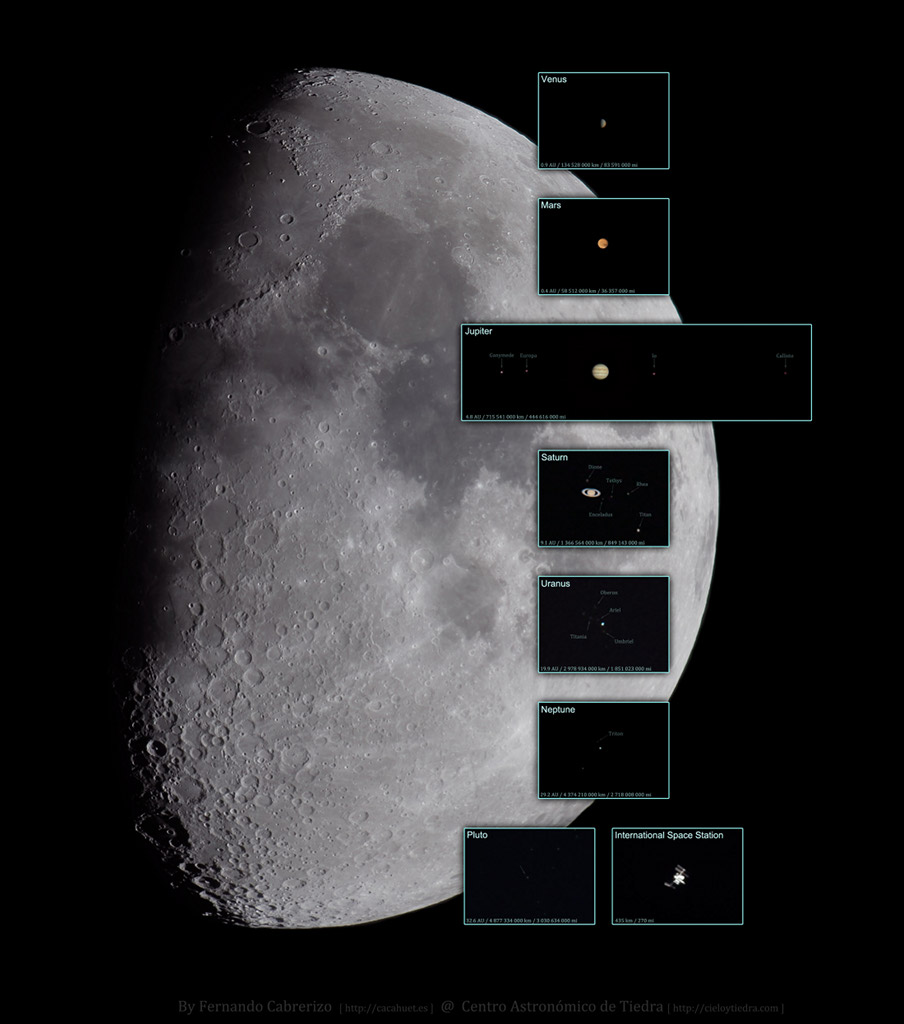
Taken on the same night, from the same place, with the same telescope and camera, these postcards from our Solar System are shown at the same scale to provide an interesting comparison of apparent sizes. Spanning about half a degree in planet Earth’s sky, the Moon is a stitched mosaic of six images. The others are the result of digitally stacked frames or simple single exposures, with the real distances to the objects indicated along the bottom of each insert. Most of the Solar System’s planets with their brighter moons, and Pluto were captured during the telescopic expedition, but elusive Mercury was missed because of clouds near the horizon. The International Space Station was successfully hunted, though. The night was July 21st. Telescope and camera were located at the Centro Astronomico de Tiedra Observatory in Spain. via NASA https://ift.tt/2LSze9G
Mars Opposition

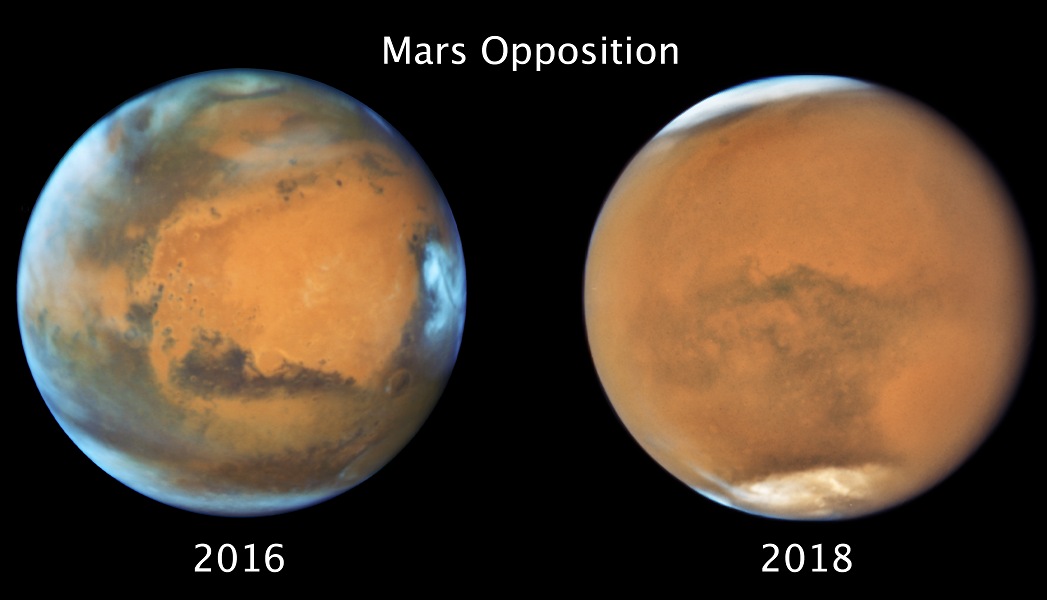
Look opposite the Sun in the sky tonight and you’ll see Mars at its brightest. Also within days of its closest approach Mars rises at sunset, near its brightest and best for telescopic observers too, except for the dust storm still blanketing the Red Planet. These two Hubble Space Telescope images compare Mars’ appearance near its 2016 and 2018 oppositions. In 2016 the martian atmosphere was clear. Captured just days ago, the 2018 image shows almost the same face of Mars. Surface features obscured by dust, the planet’s cloud enshrouded south pole is tilted more toward the Sun. Increased heat in the southern hemisphere spring and summer likely triggers planet wide dust storms. Of course, if you look opposite the Sun in the sky tonight, you’ll also see a Full Moon near Mars. Skygazers NOT located in North America could see the Red Planet near a Red Moon during a Total Lunar Eclipse. via NASA https://ift.tt/2v8fnMj

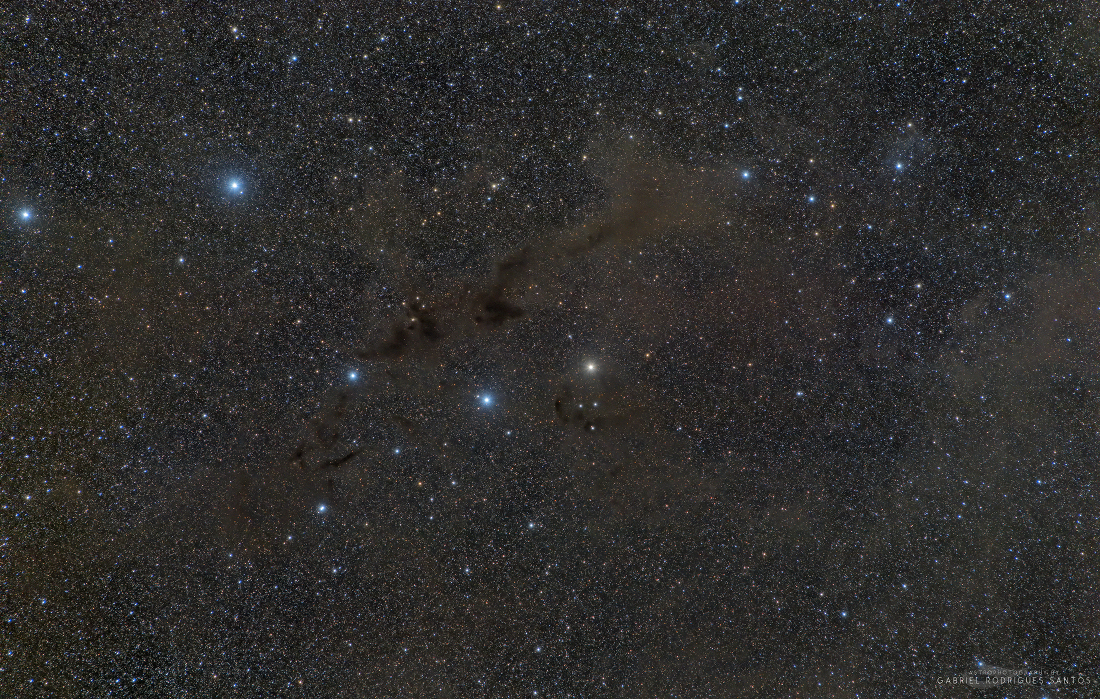
Barnard 228: The Dark Wolf Nebula in Lupus

These dark markings on the sky can just be found in silhouette against a rich, luminous background of stars. Seen toward the southern constellation of Lupus the Wolf, the dusty, obscuring clouds are part of the Lupus Molecular Cloud some 500 light-years distant. Packs of low mass stars are forming within them, from collapsing cores only visible at long infrared wavelengths. Still, colorful stars in Lupus add to this pretty galactic skyscape. It spans about 8 degrees, not far from the central Milky Way. via NASA https://ift.tt/2mHauGl

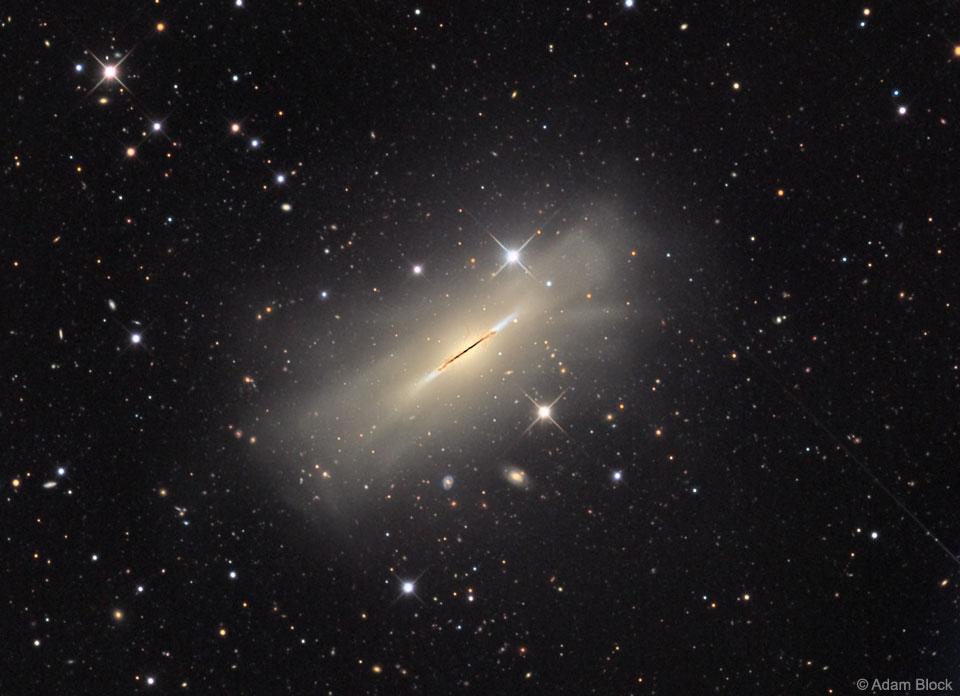
The Edge On Spindle Galaxy

What kind of celestial object is this? A relatively normal galaxy — but seen from its edge. Many disk galaxies are actually just as thin as NGC 5866, pictured here, but are not seen edge-on from our vantage point. A perhaps more familiar galaxy seen edge-on is our own Milky Way Galaxy. Cataloged as M102 and NGC 5866, the Spindle galaxy has numerous and complex dust lanes appearing dark and red, while many of the bright stars in the disk give it a more blue underlying hue. The blue disk of young stars can be seen extending past the dust in the extremely thin galactic plane. There is evidence that the Spindle galaxy has cannibalized smaller galaxies over the past billion years or so, including multiple streams of faint stars, dark dust that extends away from the main galactic plane, and a surrounding group of galaxies (not shown). In general, many disk galaxies become thin because the gas that forms them collides with itself as it rotates about the gravitational center. The Spindle galaxy lies about 50 million light years distant toward the constellation of the Dragon (Draco). via NASA https://ift.tt/2A7FIjr

Clouds of Earth and Sky

If you go high enough, you may find yourself on a picturesque perch between the water clouds of the Earth and the star clouds of the Milky Way. Such was the case last month for one adventurous alpinist astrophotographer. Captured here in the foreground above white clouds are mountain peaks in the Dolomite range in northern Italy. This multi-exposure image was captured from Lagazuoi, one of the Dolomites. Hundreds of millions of years ago, the Dolomites were not mountains but islands an ancient sea that rose through colliding tectonic plates. The Dolomites divergent history accounts for its unusually contrasting features, which include jagged crests and ancient marine fossils. High above even the Dolomites, and far in the distance, dark dust lanes streak out from the central plane of our Milky Way Galaxy. The stars and dust are dotted with bright red clouds of glowing hydrogen gas — such as the Lagoon Nebula just above and to the left of center. via NASA https://ift.tt/2JUnnWU

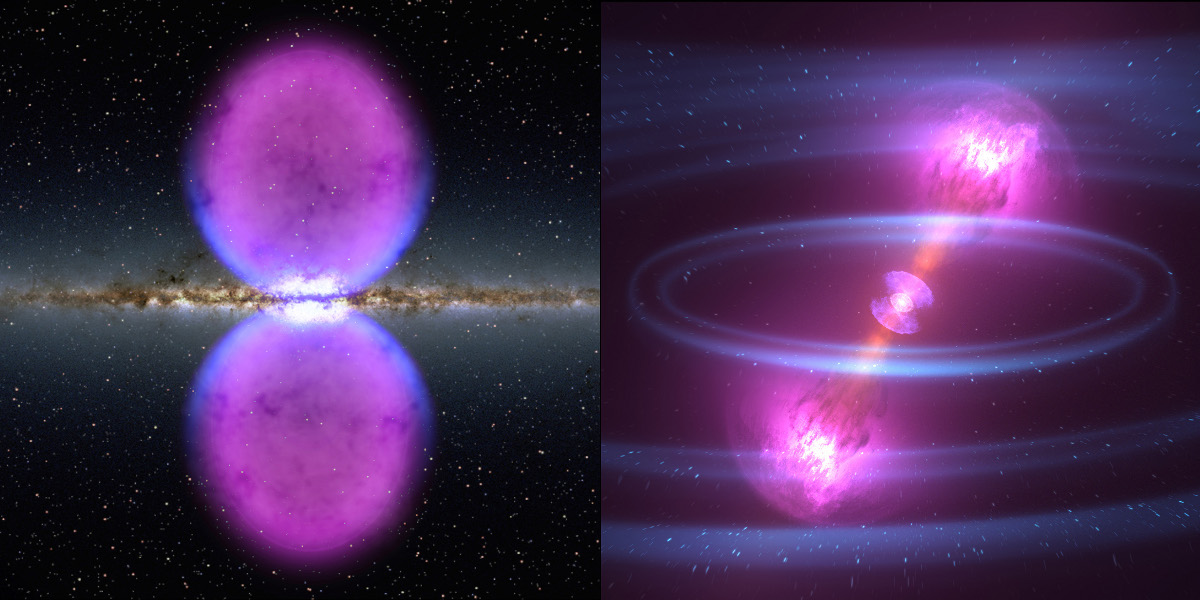
Fermi Science Finals

The Fermi Science Playoffs celebrate 10 years of the Fermi Gamma-ray Space Telescope’s exploration of the high-energy universe. Surviving all early rounds of voting, these two finalists in the competion square off at last. Digital illustrations from a list of 16 of Fermi’s top scientific discoveries, they represent the competition’s two top seeds, defeating 12th seed New Clues to Dark Matter and 14th seed Starquakes in Magnetar Storm in the semifinal round. On the left are unprecedented, unpredicted, 25,000 light-year tall Gamma-ray Bubbles above and below the plane of our Milky Way galaxy. On the right, violently merging Neutron Stars Collide to create the first gamma-ray detected gravitational wave event. Pick one now and cast your vote here to crown the most popular science result from Fermi’s first decade. via NASA https://ift.tt/2LGerG7

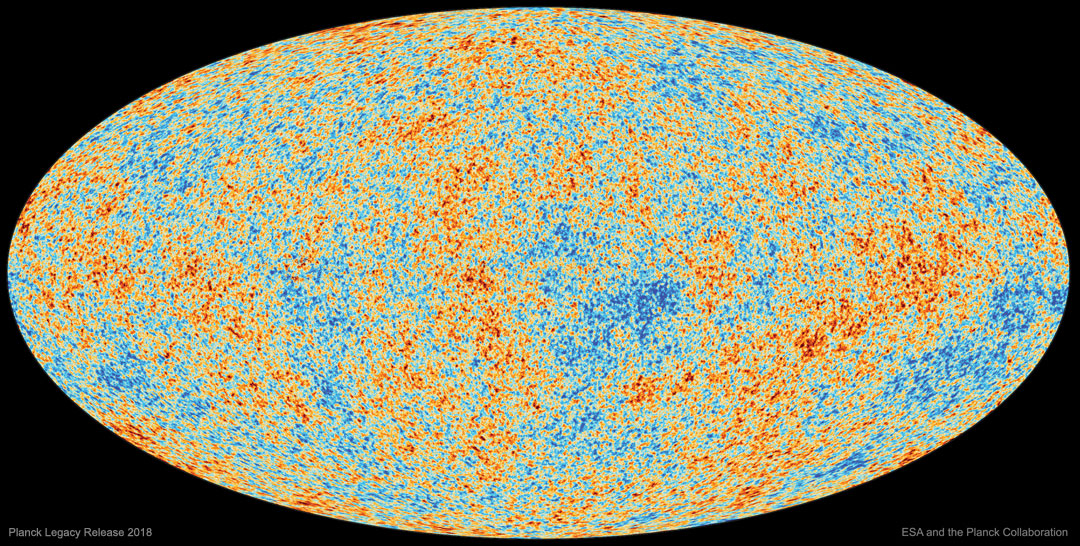
Planck Maps the Microwave Background

What is our universe made of? To help find out, ESA launched the Planck satellite from 2009 to 2013 to map, in unprecedented detail, slight temperature differences on the oldest optical surface known — the background sky when our universe first became transparent to light. Visible in all directions, this cosmic microwave background is a complex tapestry that could only show the hot and cold patterns observed were the universe to be composed of specific types of energy that evolved in specific ways. The final results, reported last week, confirm again that most of our universe is mostly composed of mysterious and unfamiliar dark energy, and that even most of the remaining matter energy is strangely dark. Additionally, the « final » 2018 Planck data impressively peg the age of the universe at about 13.8 billion years and the local expansion rate — called the Hubble constant — at 67.4 (+/- 0.5) km/sec/Mpc. Oddly, this early-universe determined Hubble constant is slightly lower than that determined by other methods in the late-universe, creating a tension that is causing much discussion and speculation. via NASA https://ift.tt/2JJfGm0

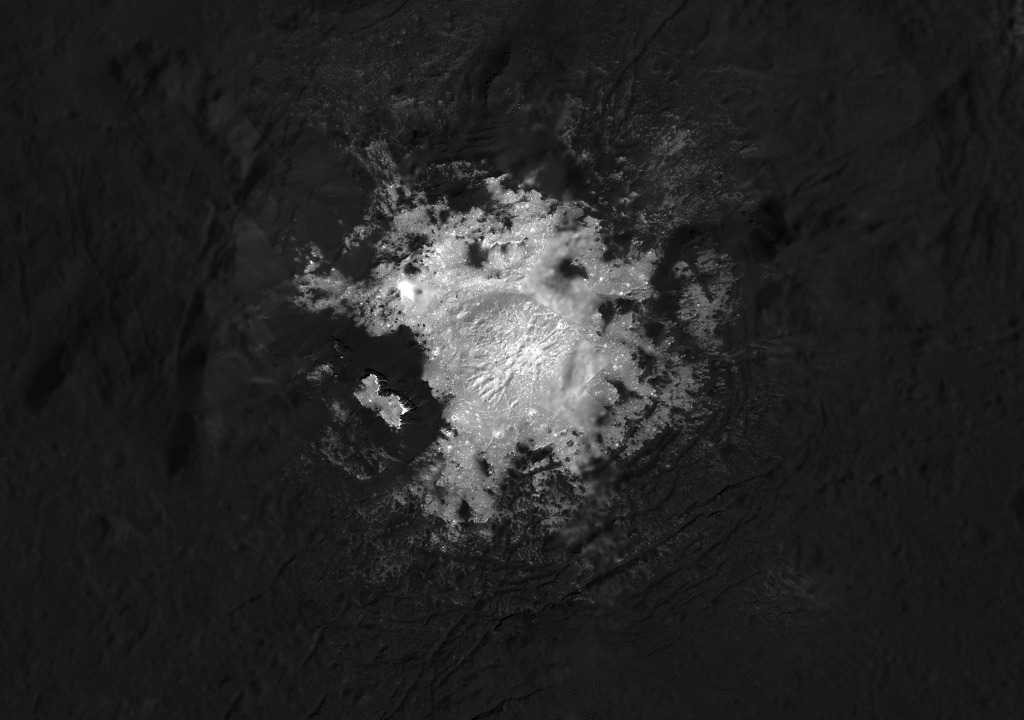
Cerealia Facula

Cerealia Facula, also known as the brightest spot on Ceres, is shown in this stunning mosaic close-up view. The high-resolution image data was recorded by the Dawn spacecraft, in a looping orbit, from altitudes as low as 34 kilometers (21 miles) above the dwarf planet’s surface. Cerealia Facula is about 15 kilometers wide, found in the center of 90 kilometer diameter Occator crater. Like the other bright spots (faculae) scattered around Ceres, Cerealia Facula is not ice, but an exposed salty residue with a reflectivity like dirty snow. The residue is thought to be mostly sodium carbonate and ammonium chloride from a slushy brine within or below the dwarf planet’s crust. Driven by advanced ion propulsion on an 11-year mission, Dawn explored main-belt asteriod Vesta before traveling on to Ceres. But sometime between this August and October, the interplanetary spacecraft is expected to finally run out of fuel for its hydrazine thrusters, with the subsequent loss of control of its orientation, losing power and the ability to communicate with Earth. Meanwhile Dawn will continue to explore Ceres in unprecedented detail, and ultimately retire in its orbit around the small world. via NASA https://ift.tt/2Jzh2zV

Dark Slope Streaks Split on Mars

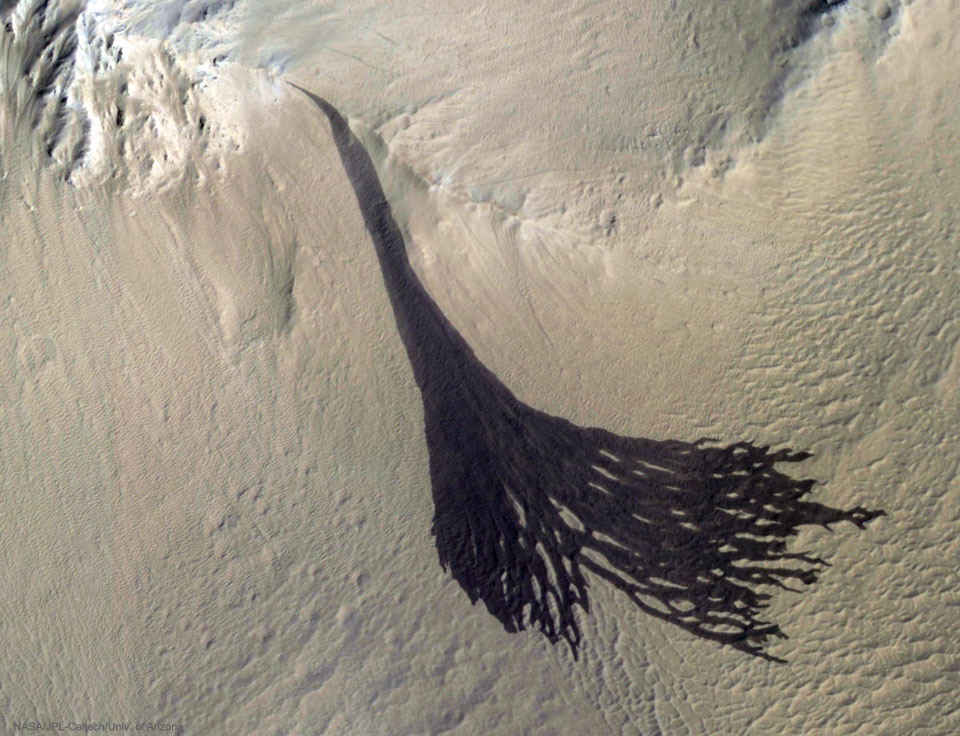
What is creating these dark streaks on Mars? No one is sure. Candidates include dust avalanches, evaporating dry ice sleds, and liquid water flows. What is clear is that the streaks occur through light surface dust and expose a deeper dark layer. Similar streaks have been photographed on Mars for years and are one of the few surface features that change their appearance seasonally. Particularly interesting here is that larger streaks split into smaller streaks further down the slope. The featured image was taken by the HiRISE camera on board the Mars-orbiting Mars Reconnaissance Orbiter (MRO) several months ago. Currently, a global dust storm is encompassing much of Mars. via NASA https://ift.tt/2uIXuDJ

Moon and Venus over Cannon Beach

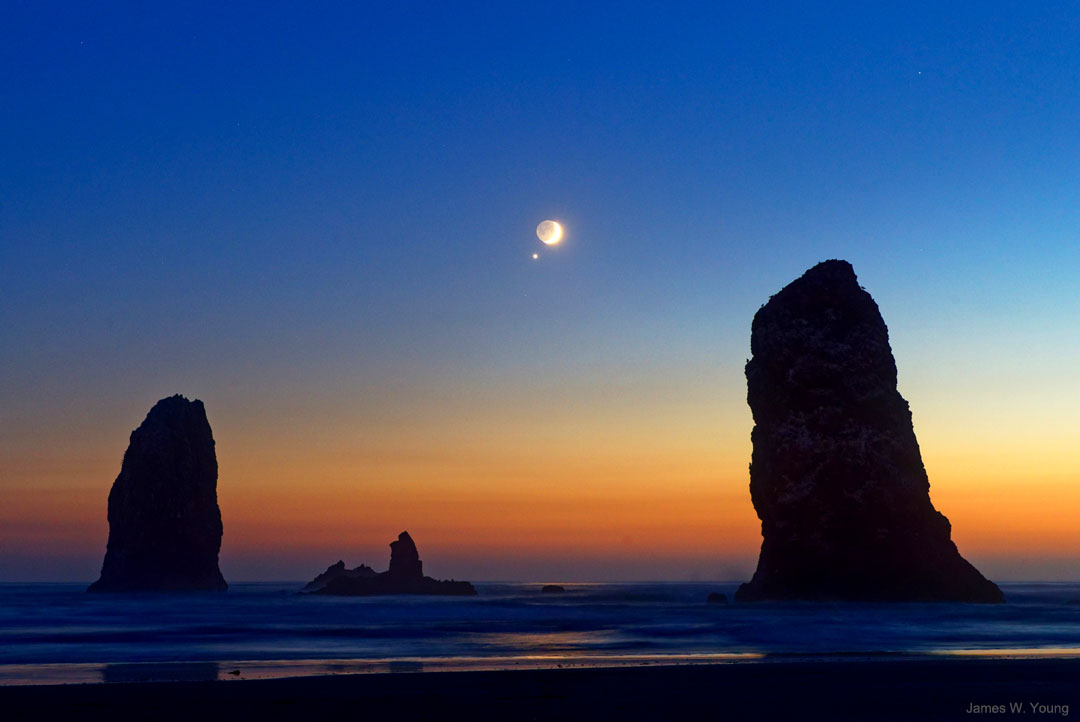
What’s that spot next to the Moon? Venus. Two days ago, the crescent Moon slowly drifted past Venus, appearing within just two degrees at its closest. This conjunction, though, was just one of several photographic adventures for our Moon this month (moon-th), because, for one, a partial solar eclipse occurred just a few days before, on July 12. Currently, the Moon appears to be brightening, as seen from the Earth, as the fraction of its face illuminated by the Sun continues to increase. In a few days, the Moon will appear more than half full, and therefore be in its gibbous phase. Next week the face of the Moon that always faces the Earth will become, as viewed from the Earth, completely illuminated by the Sun. Even this full phase will bring an adventure, though, as a total eclipse of this Thunder Moon will occur on July 27. Don’t worry about our Luna getting tired, though, because she’ll be new again next month (moon-th) — August 11 to be exact — just as she causes another partial eclipse of the Sun. Pictured, Venus and the Moon were captured from Cannon Beach above a rock formation off the Oregon (USA) coast known as the Needles. About an hour after this image was taken, the spin of the Earth caused both Venus and the Moon to set. via NASA https://ift.tt/2zKXZ62